

HomeServicesDesert landscaping & lawn conversions
04 Services
Desert landscaping and lawn conversions in St. George
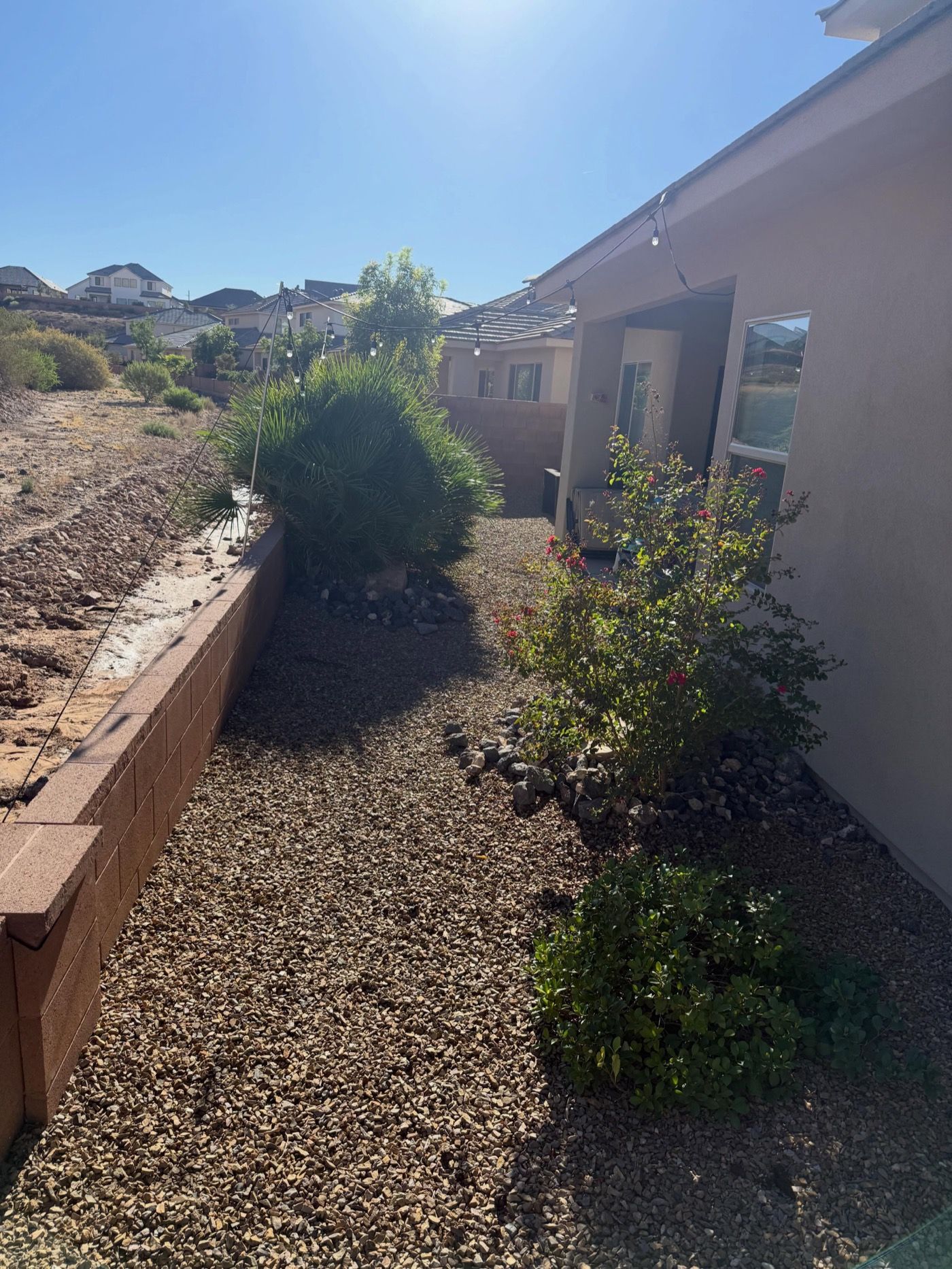
Rock mulch, desert plants on drip, and the shade that makes a yard usable in July. I build lawn-to-desert conversions to the water district’s spec so the rebate works, and I keep turf where it earns its place: a strip for the dog, a patch for the kids.
Serving St. George, Washington, Santa Clara, Ivins, Hurricane, La Verkin, Toquerville, Virgin and Mesquite, NV.
Send a photo and what you’re thinking. Zane answers his own phone.
01 Scope
What’s included.
Every line below is on the written quote, itemized, so you can see what you’re paying for and what you’re not.
- Lawn removal and haul-off, after the district’s site visit if you are claiming the rebate
- Grading, and a dry creek bed where the storm water needs a path
- Drip irrigation on its own valves, with a filter, a pressure regulator and an emitter at every plant
- Desert-adapted trees, shrubs and grasses, placed for shade and for how they will look full grown
- Rock mulch or bark at depth, with the edges set so it stays in the beds
- Flagstone steppers and paths through the planting
- Sod or turf where you still want it, sized to the rules your city and the district set
02 How I build it
The order matters more than the material.
Most of the work is under the surface. These are the steps, in the order they happen on your job.
- Apply first, if you want the rebate.You apply on the district’s site and wait for its visit before a blade of grass comes out. I can walk you through the form at the estimate visit, but the application is yours and the district decides.
- Plan the planting.Enough plants to cover half the area when they are grown, a shade tree or two where the afternoon sun hits, and a drip zone for each kind of plant. This is what the district checks and what makes the yard pleasant.
- Take out the lawn and grade.Sod and roots out, the ground shaped so water runs away from the house and into the beds, with a dry creek where the monsoon needs one.
- Drip, then plants.Valves, filter, regulator and lines go in first, every emitter tested, then the plants go in at their lines. No plant is left to a spray head.
- Mulch and finish.Rock or bark at full depth over the beds, no plastic sheeting under it, edges set, steppers in. Then the district’s final check, if you applied.
Depths, heights and what the city requires vary with the lot. The numbers for your yard are written into the quote, not guessed from a web page.
03 Money
What changes the price.
No price list, because no two yards are the same. These are the things that move the number, so the quote makes sense when you read it.
Square footage
The area of lawn coming out sets the haul-off, the rock and the drip. It is also what the rebate is paid on, so the two move together.
Plants and their size
A yard planted from small pots costs much less than one planted with mature trees and large shrubs. Small plants in this climate catch up faster than people expect.
Rock type and depth
Local gravel is the cheapest. Red rock, basalt and larger cobble cost more by the ton, and the district wants mulch at a real depth, so the volume adds up.
The drip conversion
Converting old spray zones to drip can be simple or can mean new valves and a controller. I check the existing system at the visit and quote what it actually needs.
Hardscape in the beds
Steppers, a dry creek bed, boulders and edging are the parts that make a converted yard look designed rather than stripped. They are priced by the piece.
04 Lawn-to-desert rebate
The water district pays to take out living lawn.
The Washington County Water Conservancy District runs the Water Efficient Landscape Program. It pays homeowners per square foot of living grass replaced with water-wise landscaping. You apply, the district inspects and decides, and the grass stays in the ground until its site visit is done. I build the conversion to its requirements. I don’t administer the rebate, and whether you qualify is the district’s call, not mine.
- Living plants that will cover at least half the converted area when mature (the district counts a tree as 350 sq ft and a shrub as 35 sq ft).
- Drip irrigation on its own valves, with a filter, a pressure regulator and low-flow emitters, components left visible for the inspection.
- At least 2 in of mulch: rock or bark. Ungrouted pavers and flagstone count, and so does permeable artificial turf.
- No plastic weed barrier under the mulch. New concrete is deducted from the area.
- Any lawn you keep has to be at least 8 ft wide.
Terms as of October 2026, read from the district’s pages at wcwcd.gov/welp and wcwcd.gov/welpagreement. They change; the district’s site is the source and the district’s decision is final. Cannon Landscape doesn’t run the program and has no say in who qualifies.
05 Questions
What people ask about desert landscaping and lawn conversions.
Straight answers. If yours isn’t here, text me and ask.
Will my conversion qualify for the water district’s rebate?
How much does the water district’s rebate pay?
Do I have to take out all of my lawn?
Is a desert yard just a field of rock?
What do you plant in St. George?
Does a desert yard really use less water?
When is the best time to do a conversion?
06 Also
The rest of the yard.
Most jobs are two or three of these together. Each one starts with what goes under it.
Start with a photo
Send me the yard as it is. I’ll send back what I’d build.
A text with two photos is enough to start. Or take two minutes on the estimate form and I’ll have everything I need before I come out.
Send a photo and what you’re thinking. Zane answers his own phone.